Jumat, 27 April 2018

TASK 1 SOFTSKILL BAHASA INGGRIS BISNIS 2 "Code Of Ethics Accounting"


Nama : Adiza Larasati 
NPM : 2B216913
Kelas : 3EB18 (Transfer)
Tugas  : Bahasa Inggris Bisnis 2 # (Tugas 1)


 A.   Explain about the code of ethics of accounting!
PREFACE
Part A  General Application of The Code
The mission of the International Federation of Accountants (IFAC), as set out in its constitution, is “to serve the public interest, IFAC will continue to strengthen the worldwide accountancy profession and contribute to the development of strong international economies by establishing and promoting adherence to high quality professional standards, furthering the international convergence of such standards and speaking out on public interest issues where the profession’s expertise is most relevant.” In pursuing this mission, the IFAC Board has established the Ethics Standards Board for Accountants to develop and issue, under its own authority, high quality ethical standards and other pronouncements for professional accountants for use around the world. This Code of Ethics for Professional Accountants establishes ethical requirements for professional accountants. A member body of IFAC or firm may not apply less stringent standards than those stated in this Code. However, if a member body or firm is prohibited from complying with certain parts of this Code by law or regulation, they should comply with all other parts of this Code. Some jurisdictions may have requirements and guidance that differs from this Code. Professional accountants should be aware of those differences and comply with the more stringent requirements and guidance unless prohibited by law or regulation.
INTRODUCTION
A distinguishing mark of the accountancy profession is its acceptance of the responsibility to act in the public interest. Therefore, a professional accountant’s* responsibility is not exclusively to satisfy the needs of an individual client or employer. In acting in the public interest a professional accountant should observe and comply with the ethical requirements of this Code.
This Code is in three parts. Part A establishes the fundamental principles of professional ethics for professional accountants and provides a conceptual framework for applying those principles. The conceptual framework provides guidance on fundamental ethical principles. Professional accountants are required to apply this conceptual framework to identify threats to compliance with the fundamental principles, to evaluate their significance and, if such threats are other than clearly insignificant to apply safeguards to eliminate them or reduce them to an acceptable level such that compliance with the fundamental principles is not compromised.

FUNDAMENTAL PRINCIPLES
A professional accountant is required to comply with the following fundamental principles:
(a)   Integrity
A professional accountant should be straightforward and honest in all professional and business relationships.
(b)   Objectivity
A professional accountant should not allow bias, conflict of interest or undue influence of others to override professional or business judgments.
(c)    Professional Competence and Due Care
A professional accountant has a continuing duty to maintain professional knowledge and skill at the level required to ensure that a client or employer receives competent professional service based on current developments in practice, legislation and techniques. A professional accountant should act diligently and in accordance with applicable technical and professional standards when providing professional services.
(d)   Confidentiality
A professional accountant should respect the confidentiality of information acquired as a result of professional and business relationships and should not disclose any such information to third parties without proper and specific authority unless there is a legal or professional right or duty to disclose. Confidential information acquired as a result of professional and business relationships should not be used for the personal advantage of the professional accountant or third parties.
(e)    Professional Behavior
A professional accountant should comply with relevant laws and regulations and should avoid any action that discredits the profession.


 B.   Explain about the accounting principles!
Basic Accounting Principles and Guidelines
Since GAAP is founded on the basic accounting principles and guidelines, we can better understand GAAP if we understand those accounting principles. The following is a list of the ten main accounting principles and guidelines together with a highly condensed explanation of each.

1.      Economic Entity Assumption
The accountant keeps all of the business transactions of a sole proprietorship separate from the business owner's personal transactions. For legal purposes, a sole proprietorship and its owner are considered to be one entity, but for accounting purposes they are considered to be two separate entities.
2.      Monetary Unit Assumption
Economic activity is measured in U.S. dollars, and only transactions that can be expressed in U.S. dollars are recorded.
Because of this basic accounting principle, it is assumed that the dollar's purchasing power has not changed over time. As a result accountants ignore the effect of inflation on recorded amounts. For example, dollars from a 1960 transaction are combined (or shown) with dollars from a 2017 transaction.
3.      Time Period Assumption
This accounting principle assumes that it is possible to report the complex and ongoing activities of a business in relatively short, distinct time intervals such as the five months ended May 31, 2017, or the 5 weeks ended May 1, 2017. The shorter the time interval, the more likely the need for the accountant to estimate amounts relevant to that period. For example, the property tax bill is received on December 15 of each year. On the income statement for the year ended December 31, 2016, the amount is known; but for the income statement for the three months ended March 31, 2017, the amount was not known and an estimate had to be used.
It is imperative that the time interval (or period of time) be shown in the heading of each income statement, statement of stockholders' equity, and statement of cash flows. Labeling one of these financial statements with "December 31" is not good enough–the reader needs to know if the statement covers the one week ended December 31, 2017 the month ended December 31, 2017 the three months ended December 31, 2017 or the year ended December 31, 2017.
4.      Cost Principle
From an accountant's point of view, the term "cost" refers to the amount spent (cash or the cash equivalent) when an item was originally obtained, whether that purchase happened last year or thirty years ago. For this reason, the amounts shown on financial statements are referred to as historical cost amounts.
Because of this accounting principle asset amounts are not adjusted upward for inflation. In fact, as a general rule, asset amounts are not adjusted to reflect any type of increase in value. Hence, an asset amount does not reflect the amount of money a company would receive if it were to sell the asset at today's market value. (An exception is certain investments in stocks and bonds that are actively traded on a stock exchange.) If you want to know the current value of a company's long-term assets, you will not get this information from a company's financial statements–you need to look elsewhere, perhaps to a third-party appraiser.
5.      Full Disclosure Principle
If certain information is important to an investor or lender using the financial statements, that information should be disclosed within the statement or in the notes to the statement. It is because of this basic accounting principle that numerous pages of "footnotes" are often attached to financial statements.
As an example, let's say a company is named in a lawsuit that demands a significant amount of money. When the financial statements are prepared it is not clear whether the company will be able to defend itself or whether it might lose the lawsuit. As a result of these conditions and because of the full disclosure principle the lawsuit will be described in the notes to the financial statements.
A company usually lists its significant accounting policies as the first note to its financial statements.
6.      Going Concern Principle
This accounting principle assumes that a company will continue to exist long enough to carry out its objectives and commitments and will not liquidate in the foreseeable future. If the company's financial situation is such that the accountant believes the company will not be able to continue on, the accountant is required to disclose this assessment.
The going concern principle allows the company to defer some of its prepaid expenses until future accounting periods.
7.      Matching Principle
This accounting principle requires companies to use the accrual basis of accounting. The matching principle requires that expenses be matched with revenues. For example, sales commissions expense should be reported in the period when the sales were made (and not reported in the period when the commissions were paid). Wages to employees are reported as an expense in the week when the employees worked and not in the week when the employees are paid. If a company agrees to give its employees 1% of its 2017 revenues as a bonus on January 15, 2018, the company should report the bonus as an expense in 2017 and the amount unpaid at December 31, 2017 as a liability. (The expense is occurring as the sales are occurring.)
Because we cannot measure the future economic benefit of things such as advertisements (and thereby we cannot match the ad expense with related future revenues), the accountant charges the ad amount to expense in the period that the ad is run.
8.      Revenue Recognition Principle
Under the accrual basis of accounting (as opposed to the cash basis of accounting)revenues are recognized as soon as a product has been sold or a service has been performed, regardless of when the money is actually received. Under this basic accounting principle, a company could earn and report $20,000 of revenue in its first month of operation but receive $0 in actual cash in that month.
For example, if ABC Consulting completes its service at an agreed price of $1,000, ABC should recognize $1,000 of revenue as soon as its work is done—it does not matter whether the client pays the $1,000 immediately or in 30 days. Do not confuse revenue with a cash receipt.

9.      Materiality
Because of this basic accounting principle or guideline, an accountant might be allowed to violate another accounting principle if an amount is insignificant. Professional judgement is needed to decide whether an amount is insignificant or immaterial.
An example of an obviously immaterial item is the purchase of a $150 printer by a highly profitable multi-million dollar company. Because the printer will be used for five years, the matching principle directs the accountant to expense the cost over the five-year period. The materiality guideline allows this company to violate the matching principle and to expense the entire cost of $150 in the year it is purchased. The justification is that no one would consider it misleading if $150 is expensed in the first year instead of $30 being expensed in each of the five years that it is used.
Because of materiality, financial statements usually show amounts rounded to the nearest dollar, to the nearest thousand, or to the nearest million dollars depending on the size of the company.
10.  Conservatism
If a situation arises where there are two acceptable alternatives for reporting an item, conservatism directs the accountant to choose the alternative that will result in less net income and/or less asset amount. Conservatism helps the accountant to "break a tie." It does not direct accountants to be conservative. Accountants are expected to be unbiased and objective.
The basic accounting principle of conservatism leads accountants to anticipate or disclose losses, but it does not allow a similar action for gains. For example, potential losses from lawsuits will be reported on the financial statements or in the notes, but potential gains will not be reported. Also, an accountant may write inventory down to an amount that is lower than the original cost, but will not write inventory up to an amount higher than the original cost.


SOURCE:
https://www.accountingcoach.com/accounting-principles/explanation
https://www.ifac.org/system/files/publications/files/ifac-code-of-ethics-for.pdf 

Sabtu, 25 November 2017

TUGAS 3 SOFTSKILL ETIKA PROFESI AKUNTANSI "Analisis Laporan Keuangan PT ACE HARDWARE "

Nama   : Adiza Larasati
NPM   : 2B216913
Kelas   : 4EB31(Transfer)
Tugas   : Etika Profesi Akuntansi # (TUGAS 3)

ANALISIS LAPORAN KEUANGAN
PT. ACE HARDWARE INDONESIA TBK

A.   Sejarah Singkat PT ACE HARDWARE


ACE Hardware adalah salah satu perusahaan yang memproduksi perabot terkemuka di Amerika Serikat. ACE Hardware pertama kali didirikan pada pada tahun 1924 oleh Richard Hesse, E. Gunnard Lindquist, Frank Burke, dan Oscar Fisher. Perusahaan ini bermarkas di kota Chicago, Illinois, Amerika Serikat.
Ace Stores Inc didirikan untuk memusatkan kegiatan jual-beli sejak tahun 1928. Setelah salah satu pendirinya, Hesse pensiun tahun 1973, ACE kemudian dijual kepada retailer dan menjadi koperasi. Dengan ini pemilik independen menjadi agen-pemilik dan pemegang saham di perusahaan karena ini merupakan co-sponsorship (co-op) dan bukan merupakan waralaba (franchise). Dengan sistem ini setiap toko Ace Hardware terlihat berbeda dengan toko lainnya. 
Sejak tahun 1997, ACE Hardware telah berkembang menjadi salah satu jaringan produsen perabotan rumahan terkemuka dengan 39 cabang nasional. ACE Hardware dan sekarang telah diperluas dengan tiga ACE Builders Centers dan masih terus berkembang.
Produk utama ACE Hardware dapat disimpulkan dalam lima kategori barang rumah, antara lain Paints and Sundries, Perlistrikan dan Saluran Air, Hardware and Power Tools, Bahan material bangunan, dan Outdoor Merchandising. ACE merupakan afiliasi dari perusahaan SM Group. Di Indonesia sendiri, ACE telah dibuka di Living World Mall Alam Sutera yang terletak di Tangerang Selatan yang dibangun di atas tanah seluas  14.695 meter persegi. Hingga tahun 2011, total terdapat 52 toko ACE yang tersebar di kota-kota besar di Indonesia.
B.   Analisis Rasio Keuangan
1.    Rasio Likuiditas
Rasio likuiditas merupakan rasio yang digunakan untuk mengetahui
kemampuan perusahaan dalam memenuhi kewajiban jangka pendeknya secara tepat waktu. Rasio yang biasa digunakan yaitu:
a.    Current Ratio
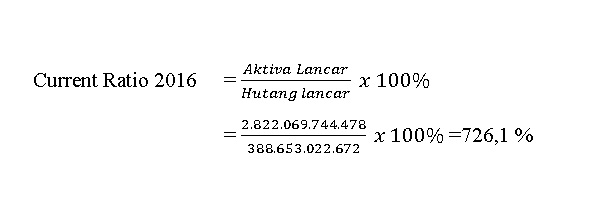
Current ratio (rasio lancar) yaitu perbandingan antara jumlah aktiva lancar
dengan hutang lancar. Rasio ini menunjukkan kemampuan suatu perusahaan memenuhi kewajiban keuangannya yang harus segera dibayar dengan memakai
hutang lancar. Rasio lancar yang ideal adalah 200% atau 2:1. Artinya, jumlah aktiva lancar adalah dua kali dari hutang lancar atau setiap satu rupiah hutang lancar harus dapat dijamin sedikitnya dengan dua rupiah aktiva lancar.
Rumus:


Analisis:
Dilihat dari perhitungan current ratio, pada tahun 2016 setiap hutang lancar Rp. 100,- dijamin oleh aktiva lancar sebesar Rp. 726,- Artinya perusahaan memiliki kemampuan yang cukup baik untuk membayar hutang lancarnya dengan asset lancar yang tersedia. Hal ini di tunjukkan tingkat rasionya yang melebihi 200% yang merupakan standar rasio cepat yang baik.

b.    Quick Ratio
Dengan rasio cepat berarti likuiditas perusahaan diukur dengan menggunakan unsur-unsur aktiva lancar yang likuid, dengan cara tidak mempertimbangkan yangkurang likuid seperti persediaan. Rasio cepat yang ideal adalah 100%, yaitu dianggap cukup memuaskan di dalam perusahaan, apabila kurang dari 100% maka dianggap kurang baik dalam tingkat likuiditasnya.
Rumus:
 
Analisis:
Dilihat dari perhitungan quick ratio, perusahaan memiliki kemampuan yang cukup baik untuk membayar hutang lancarnya dengan asset yang lebih likuid. Karena angka quick ratio perusahaan masih di atas 100%, artinya perusahaan masih memiliki kemampuan yang cukup baik.
c.    Cash Ratio
Cash ratio digunakan untuk menghitung kemampuan perusahaan dalam membayar kewajiban jangka pendek dengan kas yang tersedia dan surat berharga yang segera dapat diuangkan. Rasio ini menunjukkan porsi jumlah kas dibandingkan dengan total utang lancar. Tidak terdapat standar khusus pada rasio kas sehingga penilaiannya tergantung kebijakan perusahaan.
Rumus:
 
Analisis:
Dilihat dari perhitungan cash ratio pada tahun 2016 , rasio kas perusahaan mencapai 100% yang artinya persahaaan memiliki uang tunai yang cukup untuk melunasi utang lancarnya. Artinya perusahaan masih memiliki kemampuan yang cukup baik.

d.    Working Capital to Total Asset Ratio
Working Capital to Total Asset (WCTA) Ratio adalah Rasio yang mengukur likuiditas dari total aktiva dan pasar modal kerja neto dari jumlah aktiva.
Rumus:
 

2.    Rasio Profitabilitas
Rasio profitabilitas merupakan rasio yang menunjukkan kemampuan perusahaan untuk memperoleh keuntungan pada tingkat penjualan, asset, dan modal saham tertentu. Salah satu pengukuran rasio profitabilitas ialah Net Profit Margin. Net Profit Margin merupakan keuntungan penjualan setelah menghitung seluruh biaya dan pajak penghasilan. Net Profit Margin mengukur sejauh mana kemampan perusahaan menghasilkan laba bersih pada tingkat penjualan tertentu.
Rumus:
 
Analisis:
Pada tahun 2016 setiap Rp. 100,- penjualan yang dilakukan atas aset perusahaan mampu menghasilkan laba bersih sebesar Rp. 14,3,- . Hal ini menunjukkan bahwa kinerja perusahaan baik.
3.    Rasio Aktivitas
Rasio aktivitas adalah rasio yang menunjukkan keefektifan sebuah perusahaan dalam menggunakan aktiva yang dimilikinya. Rasio ini digunakan untuk menilai seberapa efisien perusahaan dapat memanfaatkan dan mengelola sumber daya yang dimilikinya. Salah satu pengukuran rasio aktivitas ialah Total Asset Turnover. Total Asset Turnover merupakan rasio yang megukur tingkat efisiensi dan efektivitas dari perputaran maupun pemanfaatan total aktiva dalam menghasilkan penjualan.
Rumus:
 
Analisis:
Total assets turnover digunakan untuk mengukur efektifitas penggunaan dana yang tertanam pada seluruh aktiva dalam menghasilkan pendapatan.semakin tinggi total assets turnovernya maka akan semakin baik.artinya perusahaan menciptakan penjualan yang cukup tinggi terlihat pada kemampuan aset tetap yang dimiliki perusahaan.
4.    Rasio Leverage
Rasio leverage digunakan untuk mengindikasi pengembangan yang diekspos perusahaan atas risiko keuangannya. Salah satu pengukuran rasio leverage ialah Total Debt to Total Assets. Total Debt to Total Assets merupakan bagian aktiva yang digunakan untuk menjamin kewajiban (hutang).
Rumus:
 
Analisis:
Debt ratio berguna untuk mengukur jumlah aktiva perusahaan yang dibiayai oleh hutang. Dilihat dari perhitungan debt to total assets ratio, komposisi hutang terhadap total asset relative aman karena masih dibawah 100%, yang artinya jumlah hutang jauh lebih rendah dari total asset.


C.   Cost Of Capital (Biaya Modal)
Biaya Modal (COC) adalah biaya riil yang harus dikeluarkan oleh perusahaan untuk memperoleh dana baik yang berasal dari hutang, saham preferen, saham biasa, maupun laba ditahan untuk mendanani suatu investasi atau operasi perusahaan. Penentuan besarnya biaya modal ini dimaksudkan untuk mengetahui berapa besarnya biaya riil yang harus dikeluarkan perusahaan untuk memperoleh dana yang diperlukan.
Komponen biaya modal terdiri dari :
1.    Cost of Debt (Biaya Hutang)
Biaya hutang dapat didefinisikan sebagai bagian yang harus diterima dari suatau investasi agar tingkat hasil minimum para kreditor terpenuhi. Jika perusahaan menggunakan obligasi sebagai sarana untuk memperoleh dana dari hutang jangka panjang, maka biaya hutang adalah sama dengan Kd atau Yield To Maturity (YTM) yaitu tingkat keuntungan yang dinikmati oleh pemegang atau pembeli obligasi. Biaya hutang dapat dicari dengan cara:

                                                ki = k(1 - t)     
                       
Dengan cara lain, cost of debt bisa ditentukan dengan rumus :
                        ki         = Ct / I0 (1 – t)
Keterangan :
Ki         : biaya utang
Ct        : biaya modal utang konstan
I0         : arus kas penerbitan surat berharga
K          : internal rate of return or yield
T          : marginal tax rate

Karena pada PT. ACE HARDWARE tidak terdapat hutang obligasi maka misal dapat diambil contoh sebagai berikut:

Apabila perusahaan dapat menjual obligasi dengan jangka waktu 20 tahun dengan coupon rate sebesar 9%, coupon rate dan nilai arus kas bersih atau (after underwriting expenses) sebesar Rp1.000.000,- dengan nilai obligasi sebesar Rp1.000.000,- , nilai k diperkirakan 9%. Dengan asumsi tarif pajak 30%, maka berapa besarnya biaya modal utang.
Jawab :
ki         = k(1 – t)
ki         =9% (1 – 0,3) = 6,3%

Biaya hutang ini merupakan biaya hutang sebelum pajak (pre-tax cost). Dalam menghitung WACC, yang relevan adalah biaya hutang setelah pajak (after-tax cost debt).

Biaya hutang sesudah pajak = Biaya hutang sebelum pajak x (1 - tingkat pajak)


2.    Cost of Preferred Stock (Biaya Saham Preferen)
Biaya modal dari saham preferent (cost of preferred stock) merupakan fungsi dari besarnya dividen yang ditentukan. Oleh karena saham preferen tidak memiliki jatuh tempo.
Biaya saham preferensi dapat dihitung dengan menggunakan rumus berikut:

KP = DP/PN
                        Dimana:
KP       : Biaya saham preferen
Dp       : Deviden saham preferen
Pn        :Harga saham preferen bersih yang diterima (harga setelah    dikurangi flotation cost)


3.    Cost of Equity (Saham Biasa dan Laba ditahan)
Biaya modal saham biasa dan laba ditahan atau sering disatukan menjadi biaya modal sendiri (biaya ekuitas) atau kadang-kadang disebut biaya modal saham biasa saja. Biaya modal ekuitas merupakan biaya yang dikeluarkan perusahaan yang memperoleh dana dengan menjual saham biasa atau menggunakan laba ditahan untuk investasi. Rumusnya sebagai berikut:

r s = D1 / P0 + g

Dimana :
rs         : Biaya modal ekuitas
D1       : Deviden saham yang diharapkan pada tahun pertama
P0        : Harga saham saat ini
g    : Tingkat pertumbuhan
·         Biaya Laba Ditahan (Cost of Retained Earning) 
Biaya laba ditahan adalah sama dengan tingkat keuntungan yang disyaratkan investor pada saham biasa perusahaan yang bersangkutan. Dasarnya adalah prinsip opportunity cost. Jika laba tidak ditahan, laba tersebut dibagiakan dalam bentuk deviden. Jika laba tersebut ditahan berarti  pemegang saham menginvestasikan kembali laba yang menjadi haknya  ke perusahaan (flow back fund)
Ada tiga cara menaksir biaya modal laba ditahan:
a.    Pendekatan CAPM
                        Ks = bunga bebas risiko + premi risiko
                        Ks = krf + bi (km – krf) 
Dimana:
Ks        : tingkat keuntungan yang disyaratkan pada saham perusahaan I,
Krf       : bunga bebas risiko
Km      : tingkat keuntungan yang disyaratkan pada portofolio pasar
Bi         : beta saham perusahaan i.

b.    Pendekatan discounted cash flow
Model yang digunakan untuk estimasi  adalah Gordon Model:
D1
Po =   ———–
Ks – g
Maka,                         
D1 
Ks =  ———–  + g 
Po
D1       : Deviden akhir periode
Po        : Harga saham awal periode
g          : tingkat pertumbuhan deviden.


c.    Pendekatan bond yield plus risk premium

Ks = tingkat keuntungan obligasi perusahan + premi risiko 

·         Biaya Saham Biasa Baru (Cost of New Common Stock) 
Biaya modal saham biasa baru biasanya lebih tinggi dari biaya modal laba ditahan, karena penjualan saham baru memerlukan biaya emisiatau flotation cost. Biaya emisi akan mengurangi penerimaan perusahaan dari penjualan saham.
                        D1 
Ksb =  —————–  + g 
Po (1 –FC)
Dimana:
Ksb      : biaya saham biasa baru
FC       : flotation cost

4.     Weighted  Average Cost of Capital/WACC (Biaya Modal Rata-Rata Tertimbang)
Biaya keseluruhan dari permodalan korporasi adalah rata-rata tertimbang dari setiap biaya modal, dengan menimbang proporsi dari setiap tipe penggunaan modal, yaitu seperti berikut ini.
Rumus:
WACC = Wd . k(1 – T) + Ws . Ks

Dimana:
WACC : Biaya modal rata-rata tertimbang
Wd         : Proporsi hutang dalam struktur modal
kd           : Biaya hutang (cost of debt)
Ws       : Proporsi saham biasa dalam struktur modal
Ks        : Tingkat  pengembalian yang diinginkan investor

LAMPIRAN:


Sumber:
https://profil.merdeka.com/mancanegara/a/ace-hardware/
https://text-id.123dok.com/document/6qm3o47y-analisis-laporan-keuangan-pt-ace-hardware-indonesia-tbk-yang-terdaftar-di-bursa-efek-indonesia.html
http://www.acehardware.co.id/id/about/page/financial_reports/86

TASK 3 SOFTSKILL BAHASA INGGRIS BISNIS 1 "Cover Letter (Surat Lamaran) dan CV"

Nama : Adiza Larasati NPM  2B216913 Kelas : 3EB19 (Transfer) Tugas : Bahasa Inggris Bisnis 1 # (Tugas 3) A. Berikut ini adalah ...